


 PLATFORM UPDATE:


Buchwald–Hartwig aminated pyrene-heterocycles with host–guest-enhanced NIR phosphorescence: DFT-guided design toward breast cancer imaging probes

Abstract
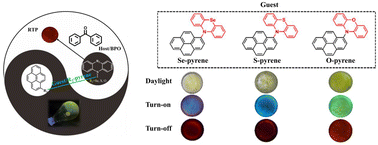
Organic near-infrared room-temperature phosphorescent (NIR-RTP) materials face fundamental challenges from the energy gap law, limiting emission efficiency of wavelengths >600 nm and long-lived triplet states. We report the rational design of Buchwald–Hartwig aminated pyrene-heterocycles embedded in benzophenone host matrices, achieving unprecedented NIR phosphorescence with ultralong lifetimes. The DFT-guided optimization reveals that the heteroatom-induced spin–orbit coupling modulation and host-mediated suppression of non-radiative transitions both overcome traditional efficiency bottlenecks. The O-pyrene/benzophenone (O-pyrene/BPO) system exhibits dual-peak emissions at 609/666 nm with lifetimes up to 275.56 ms—the reported highest value for organic NIR-RTP materials—while the S-pyrene/BPO demonstrates a 243.31 ms lifetime at 613 nm. Crucially, phenoxazine incorporation lowers the T1 energy level without compromising ISC efficiency, which is validated by SOC calculations. Host–guest confinement also restricts molecular vibrations. This work provides a research foundation for establishing the “heteroatom engineering-host rigidity” paradigm, helpful in the development of therapeutic and diagnostic imaging probes.
 Please wait while we load your content...


