


A new step in understanding the process of the lithium battery manufacturing process: analysis of the CH3CN–PF5 species in matrices at cryogenic temperatures
 a
Marcos I.
Leone,
a
Carlos O.
Della Védova,
a
Rosana M.
Romano,
*a
Mei
Wen,
b
Sebastian
Riedel
b
a
Marcos I.
Leone,
a
Carlos O.
Della Védova,
a
Rosana M.
Romano,
*a
Mei
Wen,
b
Sebastian
Riedel
b
Abstract
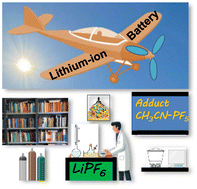
In lithium-ion battery electrolyte production, LiPF6 is the dominant salt due to its high ionic conductivity and operational stability. One synthesis method involves PF5 and CH3CN reagents, which exhibit contrasting reactivity – PF5 hydrolyzes easily, while CH3CN is chemically inert. Their interaction was studied via cryogenic matrix isolation and computational analysis. New FTIR bands, distinct from isolated monomers, indicated aggregated species with varied geometries. No photoevolution was observed under UV irradiation, and only slight changes became apparent after annealing the sample up to 30 K. Possible structures were explored using the automated docking algorithm and GFN2-xTB, positioning CH3CN (guest) around PF5 (host) to locate energy minima on the potential energy surface (PES). The 100 identified structures were grouped into two sets (CH3CN–PF5 and PF5–H3CCN) based on energy differences. Further optimization with B97M-V/def2-QZVPPD confirmed minima, enabling IR spectrum simulations. The computational model suggests an adduct formation via nitrogen (N) of CH3CN interacting with phosphorus (P) of PF5, aligning well with experimental data. This study provides insights into CH3CN–PF5 interactions relevant to LiPF6 synthesis.
 Please wait while we load your content...


