


 PLATFORM UPDATE:


Plasma-assisted CH4 activation on Cu/CeO2 catalysts: insights into the effect of catalyst surface and vibrational excitation

Abstract
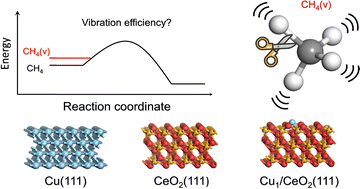
The lack of chemical understanding and efficient catalysts impedes the development of plasma–catalytic CH4 conversion. In this work, we employ density functional theory calculations to understand the effects of vibrational excitation on the dissociative chemisorption of both CH4 and CH3 on surfaces relevant for (plasma-assisted) catalysis, i.e., Cu(111), CeO2(111), and a single Cu atom supported on CeO2(111). The single-atom Cu catalyst (Cu1/CeO2(111)) shows the lowest energy barrier (0.35 eV) for CH4 dissociation among the three surfaces. The vibrational mode-specific reactivity of CH4 and CH3 is assessed using the sudden vector projection (SVP) model, in which the stretching mode of CH4 is dominant for CH4 dissociation on these three surfaces. Additionally, depending on the reaction mechanism of CH3 chemisorption and dissociation, either the stretching or bending modes are predicted to be more effective at promoting reactivity. Furthermore, vibrational efficacies for dissociative chemisorption of CH4 on the investigated catalyst surfaces are compared using a simplified model, which also employs SVP calculations, to reveal the importance of mode specificity and the structural dependence of the catalyst, offering valuable insights into catalyst design in heterogeneous and plasma catalysis.
 Please wait while we load your content...


