


 PLATFORM UPDATE:


Data-guided rational design of additives for halogenation of highly fluorinated naphthalenes: integrating fluorine chemistry and machine learning†
 ab
Norie
Momiyama
*ab
ab
Norie
Momiyama
*ab
Abstract
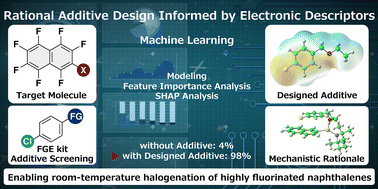
Highly fluorinated aromatic compounds exhibit unique electronic structures, however their selective transformation remains a longstanding challenge. Halogenation of F7 naphthalene previously required low temperatures (−40 to 0 °C) for high yields, while room-temperature reactions suffered from side reactions and decomposition. Here we present a data-guided framework for rational additive design enabling efficient halogenation under ambient conditions. Screening 25 functional additives revealed distinct groups, with effective ones affording halogenated products in yields above 50% and recovering in high rates. Machine learning models built from DFT-derived descriptors achieved strong predictive performance (R2 = 0.90, RMSE = 10.9). Feature importance and SHAP analyses clarified the design criteria—moderately balanced functional-group charges and non-negative aromatic contributions—as critical for reactivity. Guided by these criteria, a chlorine-substituted additive, 1-chloro-4-(ethoxymethyl)benzene (3a), was designed, predicted to give >99% yield, and experimentally validated to deliver the iodinated product in 98% yield with 96% additive recovery at room temperature. Moreover, additive 3a was effective in iodination, bromination, and chlorination, demonstrating the generality of the design principle. This study advances additive development from empirical trial-and-error to a predictive, machine learning–enabled strategy, offering guidelines for selective transformations of perfluorinated arenes.
- This article is part of the themed collection: Celebration of the 70th birthday of Prof. Giuseppe Resnati
 Please wait while we load your content...


