Measuring the Gibbs Free Energy of Mixing Using the Concept of an Osmotic Engine - Solute Activity Coefficient as a Colligative Property

Abstract

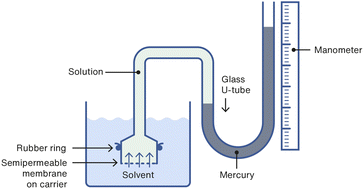
This manuscript presents a theoretical framework for quantifying the Gibbs free energy of mixing in real binary solutions. Grounded in the concept of an osmotic engine under pressure retarded osmosis, our approach combines static and dynamic membrane based osmometry to determine with high precision the excess free energy arising when two pure components are mixed. By then imagining this osmotic engine to consist of an infinite number of cylinders, a remarkably simple closed-form expression for the activity coefficient of a single solute molecule in a van’t Hoff ideal binary mixture emerges — one based purely on colligative considerations and free of semi-empirical parameters. This result can readily be extended to multicomponent systems containing both electrolytes and non-electrolytes. Finally, the same framework naturally captures solvent-dependent shifts in reaction equilibrium constants and enables routine determination of the Flory–Huggins interaction parameter between solvent and polymer.

Supplementary files

Article information

Article type
Paper
Submitted
14 Sep 2025
Accepted
31 Mar 2026
First published
07 Apr 2026
This article is Open Access
Creative Commons BY-NC license

Phys. Chem. Chem. Phys., 2026, Accepted Manuscript

Measuring the Gibbs Free Energy of Mixing Using the Concept of an Osmotic Engine - Solute Activity Coefficient as a Colligative Property

D. W. W. Nielsen and C. Hélix-Nielsen , Phys. Chem. Chem. Phys., 2026, Accepted Manuscript , DOI: 10.1039/D5CP03542B

This article is licensed under a Creative Commons Attribution-NonCommercial 3.0 Unported Licence. You can use material from this article in other publications, without requesting further permission from the RSC, provided that the correct acknowledgement is given and it is not used for commercial purposes.

To request permission to reproduce material from this article in a commercial publication, please go to the Copyright Clearance Center request page.

If you are an author contributing to an RSC publication, you do not need to request permission provided correct acknowledgement is given.

If you are the author of this article, you do not need to request permission to reproduce figures and diagrams provided correct acknowledgement is given. If you want to reproduce the whole article in a third-party commercial publication (excluding your thesis/dissertation for which permission is not required) please go to the Copyright Clearance Center request page.

Read more about how to correctly acknowledge RSC content.

Social activity

Spotlight

Advertisements