


 PLATFORM UPDATE:


Emerging ZnSeTe quantum dots as the sustainable solution for high-performance full-color QLEDs
 *a
*a
Abstract
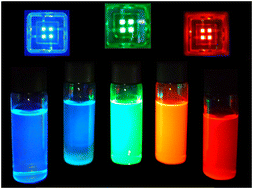
ZnSeTe alloy quantum dots (QDs) have emerged as promising Cd- and Pb-free emissive materials for quantum dot light-emitting diodes (QLEDs), owing to their tunable optical properties, environmental friendliness, and potential to rival traditional cadmium-based systems. Since QLED performance critically depends on the optical quality of QDs and interfacial engineering, controlling surface defects, achieving compositional uniformity, and optimizing core–shell architectures have become central strategies. In this Perspective, we review recent advances in ZnSeTe QDs across the full visible spectrum. We first introduce the fundamental properties and synthesis strategies of ZnSeTe alloys, followed by a discussion of blue-emitting QDs, where defect passivation and shell engineering have enabled high photoluminescence quantum yields (PL QYs) and QLEDs with external quantum efficiencies (EQEs) exceeding 20%. We then highlight green-emitting QDs, in which lattice mismatch mitigation and interfacial optimization have achieved PL QYs above 90%, and QLEDs with EQEs over 21%. The challenges of achieving stable red emission are also addressed, particularly those arising from Te precursor reactivity and spectral instability. Finally, we outline the remaining obstacles for the strict synthesis conditions, stability issues, and emission mechanisms of ZnSeTe QDs. This Perspective offers insights into the development of ZnSeTe QDs as environmentally sustainable materials for next-generation QLED applications.
- This article is part of the themed collection: 2026 PCCP Reviews
 Please wait while we load your content...


