


 PLATFORM UPDATE:

Impact of the halogen PB radii in the estimation of protein–ligand binding energies using MM-PBSA calculations†
 ab
and
Paulo J.
Costa
*ab
ab
and
Paulo J.
Costa
*ab
Abstract
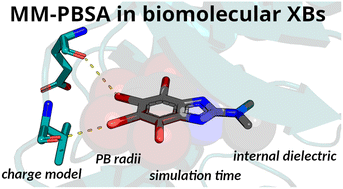
Halogenation is a widely used strategy in drug design, not only to improve ADME properties but also because halogens can form halogen bonds (XBs) with biological targets. To predict protein–ligand binding free energies (ΔGbind), paramount in drug discovery, MM-PBSA remains a popular intermediate approach between less accurate docking and more rigorous free-energy methods. However, the use of extra-points of charge (EPs) to describe halogen anisotropy and enable XB sampling in MM-PBSA calculations is still uncommon. Optimized halogen radii (ropt) for PBSA calculations, which are compatible with EPs and reproduce hydration free energies with good accuracy, were recently developed. Yet, their impact on protein–ligand binding free energy calculations has not been systematically assessed. Here, we evaluate the performance of ropt in estimating ΔGbind values for three sets of halogenated inhibitors of casein kinase-2 with available experimental binding data. We compared three EP models and standard RESP charges (no EPs), while also analyzing the effect of the internal dielectric constant (εin) and sampling time. Our results show that direct use of the X-ray structures generally leads to poor correlations, whereas relaxation through MM minimization, particularly with εin = 4, yields an improved agreement with experiment. Incorporating configurational sampling via MD can, in some conditions, further enhance the correlations, though optimal Pearson coefficients are highly dependent on both sampling length and PBSA setup. Nonetheless, optimized radii (ropt) provided slight improvements, while inclusion of halogen anisotropy through EPs also typically increased correlations. The choice of εin also influenced the quality of predictions. The use of EPs seems to be sufficient to account for the polarizability in systems with multiple halogens and thus lower εin are acceptable, but for ligands with fewer halogens, a higher εin proved beneficial. To our knowledge, this is the first comprehensive benchmark of MM-PBSA calculations using EP-based simulations, and our findings can provide practical guidelines on how to best combine EPs, optimized radii, dielectric constants, and sampling strategies for an improved description of halogen bonding in protein–ligand complexes.
- This article is part of the themed collection: Celebration of the 70th birthday of Prof. Giuseppe Resnati
 Please wait while we load your content...


