


 PLATFORM UPDATE:


A cyclic ion mobility and DFT study of the structures, isomer space and isomer interconversion of lanthanide bromide clusters, LnxBr3x+1−, x = 1–6

Abstract
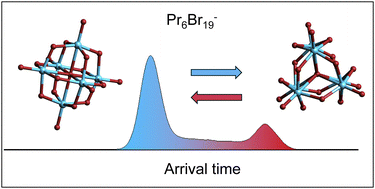
Cyclic ion mobility–mass spectrometry (IMS–MS) combined with density functional theory (DFT) and trajectory-method simulations were used to study the structures and isomerization of lanthanide bromide cluster anions LnxBr3x+1− (x ≤ 6, Ln = La–Lu, except Pm). Overall, seventy different species were characterized, revealing two regimes: smaller anions (x ≤ 5) mostly exhibit rapid isomer interconversion on the sub 10 ms timescale of the experiment while hexamers (x = 6) display enhanced rigidity and much slower interconversion dynamics. DFT-predicted minima agree with IMS data, showing essentially ionic bonding with bromide bridging and termination. The isomer space comprises structural motifs that evolve with cluster size from chain and ring topologies to compact three-dimensional frameworks at x = 6. Lanthanide contraction shifts relative isomer stabilities which typically leads to systematic structure changes across the Ln series. For Ln6Br19−, at least two long-lived isomers were observed for all lanthanides. Strikingly, Pr6Br19− undergoes spontaneous bidirectional interconversion on the experimental timescale, permitting direct measurement of unimolecular rate constants (kf = 1.8 s−1, kr = 0.2 s−1) and consequently an equilibrium constant (K ≈ 9 at 300 K).
 Please wait while we load your content...


