


 PLATFORM UPDATE:


Probing the longest λmax of azo compounds in near infrared absorption via integrating protonation, antiaromaticity and substituents: a combined DFT and machine learning study
 *a
*a
Abstract
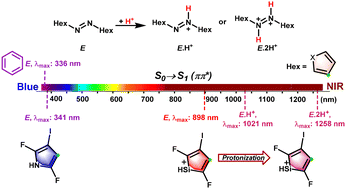
The photoisomerism of azo switches using light in the near-IR region (NIR, 780–1400 nm) is highly preferable for applications in biomedical and pharmacological fields. The common chemical modifications of azobenzene only enable the E ⇆ Z photoswitching wavelengths of azobenzene derivatives close to the red limit of near-infrared light. Here, we demonstrate that the introduction of protons and antiaromaticity, especially diprotonation, enables significantly red-shifted π → π* bands of E and Z forms via time-dependent density functional theory (TD-DFT) calculations, leading to the λmax of the π → π* band of the E form of 17e.2H+ to be 1258 nm and its Z form to be 1036 nm. Population of π-electrons from the 5MR to the CN bond results in the reduction of their HOMO and LUMO energies, especially for LUMO energies, leading to remarkable red-shifts of the λmax of the first π → π* absorption bands in heteroazonium ions. Machine learning study suggests that antiaromaticity has the greatest influence on λmax. Our work demonstrates the longest λmax of π → π* bands in azo switches through theoretical calculations, inviting experimental verifications of these novel azo species.
 Please wait while we load your content...


