


 PLATFORM UPDATE:


Coexistence of ferromagnetism and enhanced photo-response in Fe-doped SnSe2 single crystals
 a
and
P. A.
Bhobe
*a
a
and
P. A.
Bhobe
*a
Abstract
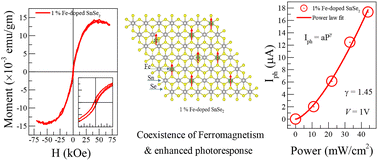
In this work, we report the synthesis and comprehensive characterization of pristine and Fe-doped SnSe2 single crystals, revealing how light Fe doping enhances photoconductivity and induces magnetism in this layered 2D material. Fe substitution leads to a reduction in its band-gap and activation energy, as noted from its electrical transport measurements. Its phonon characteristics and crystal symmetry remain unaltered, as confirmed from temperature-dependent Raman spectroscopy measurements. Magnetic measurements demonstrate that even low Fe concentrations induce a ferromagnetic interaction in otherwise diamagnetic pristine SnSe2 and this interaction increases with increasing Fe-concentration. Photoconductivity measurements demonstrate a pronounced superlinear photocurrent response in both pristine and Fe-doped SnSe2-based photodetectors. A model based on three recombination centers is proposed to explain this superlinear behavior. Interestingly, 1% Fe-doped SnSe2 exhibits the highest external quantum efficiency (∼1.4 × 10⁴%) and detectivity (∼1012 Jones), along with a reduced response time. The coexistence of robust ferromagnetism and superior photodetector performance in Fe-doped SnSe2 highlights its potential as a promising candidate for next-generation spintronic, optoelectronic, and energy-related applications.
- This article is part of the themed collection: 2026 PCCP HOT Articles
 Please wait while we load your content...


