


 PLATFORM UPDATE:


Differential sequence charge clustering and mixing ratio affect stability and dynamics of heterotypic peptide condensates

Abstract
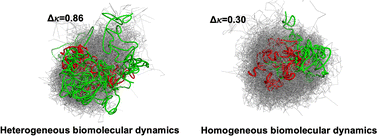
Phase separation has emerged as a central mechanism through which cells organize their material components, and it is extremely important in tuning various biological regulations. However, such condensates in cellular media are often heterogeneous in nature in terms of proteins and the presence of polynucleotides in different concentrations. This study explored the stability and dynamics of heterotypic coacervates formed by polyampholyte binary peptides having differential charge-clustering limits. A systematic increase in the differential charge-clustering in the peptide pairs tuned the origin of the heterogeneity and resulted in an enhanced stability of the droplet compared to the homogeneous ones with the same average charge clustering of the two peptide pairs. In addition, the stability of the condensate phase was linearly enhanced with an increase in the high charge-clustering polymers in the system. The peptides with higher charge-clustering diffused 3–4 times slower within the condensate phase than the lower charge-clustering ones due to heterogeneity in the structural morphology of the droplets, which diminished when the difference of charge clustering among the sequence pairs forming the condensate was lowered. Coupled with the differential diffusivity of the polymers in the condensates, droplet diffusion was nearly 7–35 times lower than that of the bulk phase, depending upon the mixing fractions of the polymers and variable sequence charge clustering. The condensates with moderate heterogeneity showed an enhanced arrestation than the most heterogeneous condensates, likely due to their complementarity and better packing, as indicated by the energetics of the condensate. This study quantifies the fundamental microscopic properties of heterotypic condensates formed through long-range electrostatic forces, particularly how they can be modulated by the differential charge patterns in sequences and the systematic mixing of fractions.
 Please wait while we load your content...


