


 PLATFORM UPDATE:


Molecular engineering of antiaromatic orangarin-based sensitizers for high-performance dye-sensitized solar-cell applications

Abstract
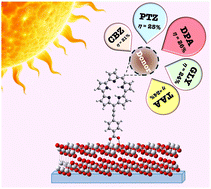
To meet increasing energy demand, several molecules have been explored as dyes for dye-sensitized solar-cell (DSSC) applications. However, such designed cells are yet to attain a solar-power conversion efficiency (η) of more than 13%. To achieve this, new molecules should be investigated. In this work, for the first time, an antiaromatic metal-free molecule is explored for DSSC applications. We consider the antiaromatic orangarin core and load it with different donor and acceptor moieties at rationally chosen places that can enhance the absorption of sunlight. In this way, we design ten potential candidates for use as dyes in DSSCs. The photovoltaic properties, including the light-harvesting efficiency (LHE), open-circuit voltage, maximum short-circuit current density, fill factor, and η of all the designed molecules are calculated and analyzed using the state-of-the-art density functional theory and time-dependent density functional theory methods. Our study reveals that the antiaromatic nature of the core indeed increases the absorption strengths of the dyes and hence enhances the LHE and η up to an incredible value of 26%. The present study clearly demonstrates that an antiaromatic core should be explored further for DSSC application.
- This article is part of the themed collection: Celebrating International Women’s day 2026: Women in physical chemistry
 Please wait while we load your content...


