


 PLATFORM UPDATE:


Contemporary DFT: learning from traditional and recent trends for the development and assessment of accurate exchange–correlation functionals

Abstract
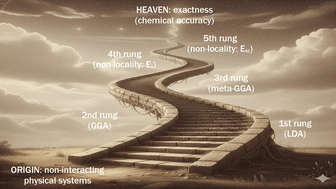
Density functional theory (DFT) is the most widely and accepted model for calculating the electronic structure of physical systems, but practical applications rely on approximations to the (still) unknown exact exchange–correlation functional. We revisit here the main advances, families, and tipping points for the development of accurate expressions for the exchange–correlation functional, focusing on the historical evolution followed by DFT but also on the underlying reasons for that, while emphasizing both the theoretical foundations and the last methodological and technical developments (exemplified by deep-learned models). The latter are built by training a neural network on a very extended collection of molecular data, with the DM21, the aPBE0-ML, and the Skala functionals now available using such a strategy. This degree of development could have not been possible without the knowledge achieved so far, after more than half a century of investigations and applications of DFT to all kind of systems, and it is rooted on the traditional local (LDA), semi-local (GGA or meta-GGA) and non-local (hybrid and double-hybrid) functionals, which are still important pillars of DFT and are expected to coexist with deep-learned models, as well as on the creation of large and diverse datasets of nearly-exact reference results, which are also needed to train any of the deep-learned models envisioned.
- This article is part of the themed collection: 2026 PCCP Reviews
 Please wait while we load your content...


