


 PLATFORM UPDATE:


Insight into the temperature-dependent lattice thermal properties of CeO2 stabilized ZrO2 by machine learning force fields

Abstract
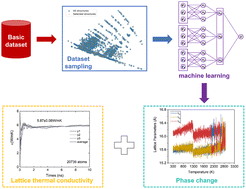
The lattice thermal conductivity (LTC) and related properties of the ZrO2–CeO2 system are critically important for industrial applications, particularly in thermal protection. However, elucidating the complex atomic-scale processes governing these phenomena remains challenging. In this work, the farthest point sampling (FPS) method was employed to sample the dataset, and a machine learning (ML) approach was applied to fit the sampled data, successfully deriving the interatomic potential. This methodology overcomes the limitations related to size and temperature effects inherent in density functional theory. Thermodynamic processes (including phase transitions and lattice thermal conductivity) in a large ZrO2–CeO2 superlattice system containing 20 736 atoms were investigated using the neuroevolution potential (NEP) framework within molecular dynamics simulations. Significant first-order and second-order phase transitions were observed during heating. The homogeneous non-equilibrium molecular dynamics (HNEMD) method was applied to examine variations in thermal conductivity due to lattice size effects, while NEP-based MD simulations were used to predict the lattice thermal conductivity at different doping concentrations. At room temperature, the system exhibits relatively low thermal conductivity. To understand the underlying mechanisms of these thermal transport properties, spectral decomposition analysis was further conducted.
 Please wait while we load your content...


