


 PLATFORM UPDATE:


Cooperative many-body interactions and spectroscopic signatures in (HCN)n and (HNC)n clusters up to n = 15

Abstract
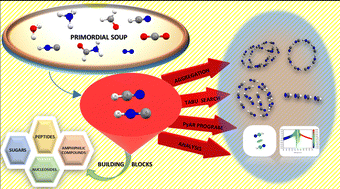
We present a comprehensive computational investigation of hydrogen cyanide (HCN) and its higher-energy isomer, hydrogen isocyanide (HNC) clusters, from dimers to 15-mers. Clusters were generated using the PyAR automated build-up algorithm, which incrementally assembles n-mers from monomers via random orientations and Tabu-guided sampling, followed by BP86-D3/def2-SVP preliminary optimizations and final refinement at B97-D3BJ/def2-TZVPP. We applied energy decomposition to break down the binding energy into electrostatic, dispersion, and induction components. We used noncovalent-interaction maps to trace the formation of spiral and dual-ring hydrogen-bond networks. We examined bond-critical-point properties to track the incremental increase in bond strength that signals cooperative enhancement as cluster size grows. Our many-body decomposition goes further, isolating two-, three-, and four-body contributions to show that while pairwise interactions dominate, three- and four-body terms account for up to ∼20% of the total interaction energy—peaking at the trimer and then leveling off by n ≈ 6—and that HNC clusters consistently exhibit larger non-additive enhancements than HCN. Vibrational analysis further confirms this trend: as cluster size increases, the CH stretch in HCN and the NH stretch in HNC both shift steadily to lower wavenumbers, reflecting a gradual weakening of the isolated X–H bond and a corresponding strengthening of intermolecular hydrogen bonds. Additionally, QTAIM analyses confirmed an increase in electron densities and a positive Laplacian at bond critical points with increasing cluster size. Overall, these findings highlight the cooperative forces that drive unexpected isomeric stabilization and novel structural motifs—results directly relevant to astrochemical modeling of interstellar HCN/HNC abundance ratios and prebiotic chemistry in early Earth or cometary environments.
 Please wait while we load your content...


