


 PLATFORM UPDATE:


Deciphering competitive water–toluene adsorption mechanisms on oxide surfaces

Abstract
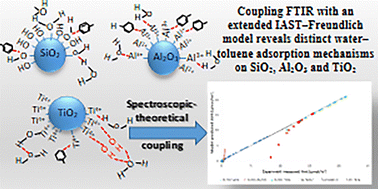
Understanding how polar and nonpolar molecules compete for oxide surfaces is essential for controlling interfacial reactivity and hydrophobicity. Herein, we report the coupling of in situ FTIR spectroscopy with an extended IAST–Freundlich model to quantitatively probe water–toluene co-adsorption on SiO2, Al2O3, and TiO2. This integrated approach links vibrational fingerprints to thermodynamic parameters, revealing both site selectivity and surface restructuring under mixed-vapor conditions. Quantitative analysis shows that SiO2 exhibits the highest water uptake owing to its large surface area, while TiO2 features stronger but more localized hydroxyl interactions; Al2O3 displays intermediate, reversible adsorption governed by Lewis acidity. Spectral evolutions distinguish three competitive regimes: water displacement by toluene on SiO2, co-adsorption on Al2O3, and complete water-driven substitution on TiO2. The combined FTIR–IAST framework establishes a consistent hierarchy of adsorption affinities and offers a transferable strategy for quantitative spectroscopic evaluation of competitive adsorption on heterogeneous catalysts.
 Please wait while we load your content...


