


 PLATFORM UPDATE:


Completing the hierarchy of rotational defects in monolayer MoS2 through symmetry-aware evolutionary search

Abstract
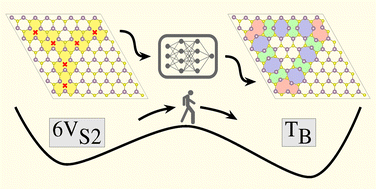
Monolayer molybdenum disulfide (MoS2) shows a plethora of defect configurations, which constitutes the basis for tailoring material properties through defect engineering. Detailed characterization of these defects remains challenging due to the complexity of the potential energy surface. We efficiently explore the three-fold rotational defect potential energy surface in monolayer MoS2 by combining an evolutionary algorithm with a machine-learning force field. To improve the performance of the structure searches, the algorithm hierarchically restricts the exploration process to a lower-dimensional subspace, utilizing the symmetry operators associated with the investigated defects. We demonstrate that these constrained trajectories exhibit lower global uncertainty measures during the evolution, produce final structures with lower energy distributions and converge faster. Our approach results in the discovery of several novel structures with reasonable computational effort, thereby completing the hierarchy of rotational defects in MoS2.
 Please wait while we load your content...


