


 PLATFORM UPDATE:


Identification of defects in pure and Al/Ga-doped ZnO to improve X-ray detector performance: experimental and simulation methods
 *a
Mehdi
Janbazi,
*b
*a
Mehdi
Janbazi,
*b
Abstract
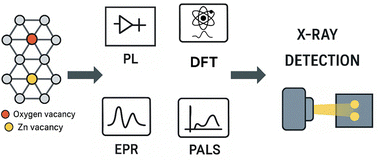
ZnO is an essential material used in various devices, but its performance can be significantly enhanced by introducing or removing defects, such as oxygen and zinc vacancies. In this article, we explore the relationship between different types of defects in pure and Al/Ga-doped ZnO and their corresponding optical and electronic properties, which are vital for X-ray detection. The nanoparticles were initially synthesized using the sol–gel auto-combustion method, with calcination temperatures of 400 °C, 500 °C, and 600 °C. The samples were then analyzed using multiple techniques, including XRD, FESEM, FTIR, photoluminescence (PL), electron paramagnetic resonance (EPR), and positron annihilation lifetime spectroscopy (PALS). Subsequently, DFT+U calculations were conducted to examine the electrical, optical, and theoretical EPR properties, as well as to identify defects that occur at different calcination temperatures. Analyzing the connection between defects and PL spectra in X-ray scintillation detectors, along with exploring the relationship between electron and hole concentrations in X-ray semiconductor detectors, provides valuable insights into the fundamental properties of ZnO. These insights pave the way for utilizing ZnO in developing next-generation scintillation and semiconductor X-ray detection technologies.
 Please wait while we load your content...


