


 PLATFORM UPDATE:


Zinc-mediated multimerization of the N-terminal CCHC zinc finger domain of BCL11B: a key to stability and a potential therapeutic target

Abstract
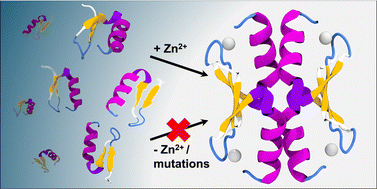
The transcription factor B cell lymphoma/leukemia 11B (BCL11B) homomultimerizes via its N-terminal CCHC-type zinc finger domain. Our previous findings revealed that BCL11B forms tetramers, rather than the initially predicted dimers. This requires a deeper understanding of the nature of these higher-order interactions. Here, we present a comprehensive biophysical characterization of the wild-type domain and selected mutants, with a focus on their dependency on Zn2+ for structure, stability, and multimerization. The mutations were selected to probe the role of hydrophobic interactions (I70A), and to alter the zinc coordination sphere to CCCC (H76C), or the more common C2H2 motif (C81H). Size exclusion chromatography showed higher-order complexes with Zn2+, and circular dichroism spectroscopy revealed a typical zinc finger fold. Both complex size and secondary structure were reversibly altered by Zn2+ removal and re-addition. Melting temperature analysis showed that Zn2+-bound species are more stable, with tetrameric complexes exhibiting higher thermal stability than dimers. Isothermal titration calorimetry indicated that tetrameric species have higher affinities to Zn2+ than dimers. The I70A mutation, located outside the canonical zinc coordination sphere, affected zinc binding affinity and multimerization. Substitution with Co2+, monitored by UV-vis spectroscopy, confirmed the tetrahedral coordination geometry and revealed differences in half-lives among the variants. These findings emphasize the central role of Zn2+, suggesting a cooperative effect between hydrophobic interactions, multimerization, and zinc binding stability. The dynamic and reversible nature of Zn2+-mediated folding and assembly highlights this domain as a potential therapeutic target. Our study provides a foundation for future strategies that aim to target the degradation of BCL11B.
 Please wait while we load your content...


