Immobilization of Ca2+ by OH- ions on calcium silicate hydrates †

Abstract

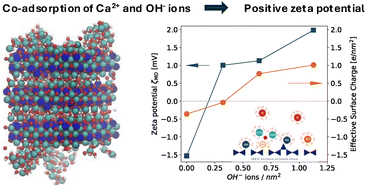
The interface of calcium silicate hydrate (C-S-H) plays a a crucial role in the mobility of ions through hardened cement paste and thus in the long term durability of concrete structures. Here, we combine experimental zeta potential measurements with non-equilibrium molecular dynamics simulations to elucidate the surface state of C-S-H under cement-relevant conditions. Our findings reveal that the co-adsorption of Ca2+ and OH- ions overcompensates the negative surface charge of C-S-H, originating from deprotonated silanol groups, thereby forming a surface adsorption network.This mechanism is governed by the interplay between solution pH and calcium speciation, where higher pH values favor the formation of calcium-hydroxide solution complexes. Consequently, an increase in pH leads to a higher Ca/Si ratio in C-S-H and a greater adsorption of these complexes, further increasing the effective surface charge density. Conversely, a reduction in pH promotes ion desorption, leading to a progressive decrease in the Ca/Si and the decrease in effective surface charge. These findings provide new insights into the long-term compositional evolution of C-S-H in cement paste, with implications for phase stability, mechanical performance, and concrete durability.
Supplementary files

Transparent peer review

To support increased transparency, we offer authors the option to publish the peer review history alongside their article.

View this article’s peer review history

Article information

Article type
Paper
Submitted
24 Jul 2025
Accepted
05 Jan 2026
First published
07 Jan 2026
This article is Open Access
Creative Commons BY-NC license

Phys. Chem. Chem. Phys., 2026, Accepted Manuscript

Immobilization of Ca2+ by OH- ions on calcium silicate hydrates †

Z. Casar, L. Mismetti, M. Harris, C. Greenwell, K. Scrivener, M. Předota and P. Bowen, Phys. Chem. Chem. Phys., 2026, Accepted Manuscript , DOI: 10.1039/D5CP02821C

This article is licensed under a Creative Commons Attribution-NonCommercial 3.0 Unported Licence. You can use material from this article in other publications, without requesting further permission from the RSC, provided that the correct acknowledgement is given and it is not used for commercial purposes.

To request permission to reproduce material from this article in a commercial publication, please go to the Copyright Clearance Center request page.

If you are an author contributing to an RSC publication, you do not need to request permission provided correct acknowledgement is given.

If you are the author of this article, you do not need to request permission to reproduce figures and diagrams provided correct acknowledgement is given. If you want to reproduce the whole article in a third-party commercial publication (excluding your thesis/dissertation for which permission is not required) please go to the Copyright Clearance Center request page.

Read more about how to correctly acknowledge RSC content.

Social activity

Spotlight

Advertisements