


 PLATFORM UPDATE:


Molecular density functional theory with atomistic dipolar solvent to study pressure effect on a Diels–Alder reaction

Abstract
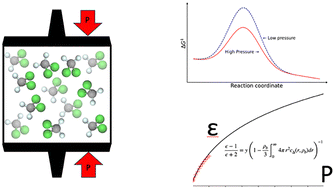
In the present work, we have extended molecular density functional theory (MDFT) to study model solvents at high pressure and how chemical reactivity can be modified. Notably, we have considered an example of Diels–Alder reaction in model non-polar (CCl4) and polar (CH2Cl2) solvents. MDFT allows the calculation of solvation free energies for different chemical structures along the reaction pathway at different pressures. These energies, combined with (electronic) density functional theory calculations providing energetic differences between reactants, transition states, intermediates and products structures, allow us to obtain the reaction free energy profiles in a wide pressure range (from ambient to 1.5 GPa). Special attention was paid to the role of the solvent dielectric response and its influence on reaction kinetics. The model makes it possible to reproduce the experimental dielectric constant at intermediate pressures (0–0.2 GPa) and to predict its increase at high pressures in the GPa range. The numerical findings are in line with the experimental observations, showing that the reaction is promoted by high pressures and that a trans/cis diastereoselectivity is induced in the product distribution. It is shown that electrostatic interactions play a major role in these findings. Finally, we can obtain the activation volume, which is a reference quantity in pressure dependent reactivity, as a direct result of our calculations, with values in agreement with what experimentally typically observed.
 Please wait while we load your content...


