


 PLATFORM UPDATE:


Azurin-based peptide p28 disrupts p53–HDM2 interactions: insights from in silico studies

Abstract
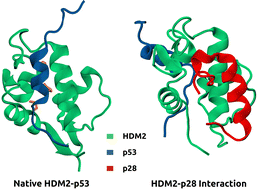
This study investigates the potential anticancer activity of the azurin-derived peptide p28 through its molecular interactions with human double minute 2 (HDM2), a key negative regulator of the tumor suppressor protein p53. By binding to the p53 transactivation domain, HDM2 impairs p53's tumor-suppressive functions. Using the information-driven docking platform HADDOCK, we generated ten plausible binding poses of p28 with the HDM2 N-terminal domain. Each pose was subsequently refined via three independent 300 ns all-atom molecular dynamics simulations, resulting in a cumulative 9 µs trajectory. Although this workflow does not capture spontaneous binding or pose interconversion, it enables systematic refinement and stability assessment of docking-generated complexes. From this analysis, three stable conformations (D3, D4, and D5) have emerged, consistently occupying the HDM2 hydrophobic pocket and exhibiting favorable binding energies (MMPBSA). Residue-level interaction analysis revealed that p28 engages HDM2 hotspots important for p53 recognition, suggesting a competitive mode of binding. While experimental studies and enhanced sampling simulations are required to fully validate these findings, our results provide a refined structural basis for understanding how p28 may interfere with HDM2–p53 interactions and support its promise as a peptide-based anticancer candidate.
 Please wait while we load your content...


