


 PLATFORM UPDATE:


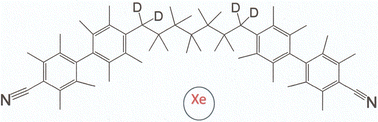
Properties of CB7CB-D4 as derived from 129Xe and 2H NMR experiments and computations
 *a
and
Juha
Vaara
a
*a
and
Juha
Vaara
a
Abstract
Twist-bend nematic liquid crystal phases are fundamentally interesting as chiral macroscopic structures arising from achiral molecules, as well as from the perspectives of photonics and switching applications. Conical angle and orientational order are the key properties of the twist-bend nematic phase. In the present case, we investigate the conical angle in 1″,7″-bis(4-cyanobiphenyl-4′-yl)heptane (CB7CB), which displays ordinary nematic (N) and twist-bend nematic (NTB) phases, utilizing 129Xe shielding and 2H quadrupole splitting in CB7CB-D4. When applying the 129Xe shielding, measured with respect to an external gaseous xenon sample, the bulk susceptibility effect must be considered. For this purpose, the diamagnetic susceptibility tensor was computed. The analysis of the 2H NMR data necessitates the knowledge of the 2H quadrupole coupling tensor element along the C–D bond. Computations and data analyses show that the commonly used value of 168 kHz is slightly underestimated. Another property investigated is the temperature dependence of the 129Xe linewidth (ν1/2). It reveals two things: (i) when approaching the phase transitions from the high-temperature side, ν1/2 increases abruptly, but decays, after the transition, exponentially toward the values in the isotropic phase, and (ii) upon cooling under ca. 355 K in the NTB phase, ν1/2 increases exponentially. Subtraction of the linewidth distributions at the phase transitions reveals that ν1/2 remains independent of temperature in the isotropic and nematic phases, and partially also in the twist-bend nematic phase. The assumption that the 129Xe linewidth reveals the T2 relaxation rate, 1/T2, leads to the conclusion that the rate is independent of temperature in the isotropic and nematic phases and partially also in the twist-bend nematic phase.
 Please wait while we load your content...


