


 PLATFORM UPDATE:


Solvent-induced structural and optical transformations in a hybrid copper phosphate framework

Abstract
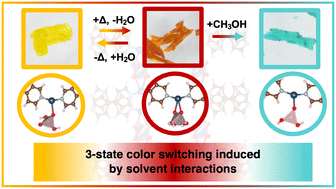
Crystalline materials that undergo coupled structural and optical transformations in response to external stimuli are of broad interest in solid-state chemistry. Here, we report a crystalline hybrid copper phosphate, Cu4(4,4′-bipy)4(H2PO4)4·6H2O, that exhibits solvent-programmable structural and optical switching driven by dehydration and methanol uptake. The material crystallizes with undercoordinated Cu(I) centers in a porous framework stabilized by π–π stacking and hydrogen bonding. Upon heating, dehydration induces a reversible color change from yellow to deep red, accompanied by a crystallographic transformation from a low-symmetry triclinic phase to a higher-symmetry monoclinic phase with distorted tetrahedral Cu coordination. Variable temperature X-ray diffraction and UV-vis spectroscopy correlate this transformation with a red-shift in the metal-to-ligand charge transfer (MLCT) band. Exposing the dehydrated phase to dry methanol drives a different symmetry-breaking crystallographic transformation, in which ordered, directional methanol-framework interactions stabilize trigonal planar Cu(I) centers and produce a distinct cyan color. Together, these results demonstrate how solvent identity, hydrogen bonding directionality, and coordination geometry can be crystallographically coupled to achieve multiple optical responses and switching in a single hybrid phosphate material. This work establishes hybrid phosphate frameworks as a platform for post-synthetic structural and optical switching, accessing crystalline phases that are unreachable through traditional synthetic routes.
- This article is part of the themed collection: Coordination Networks
 Please wait while we load your content...


