


 PLATFORM UPDATE:


Complete structural and electronic comparison of chiral and racemic ketohexoses: hydrogen-bond network topology and interaction strength distribution

Abstract
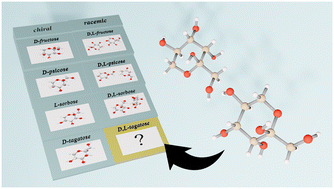
Racemic crystals are generally expected to exhibit higher densities than their enantiopure counterparts owing to complementary packing of enantiomers (Wallach's rule), yet the structural origin of its deviation in hydrogen-bonded systems remains unclear. Here, we present a systematic comparison of four ketohexoses in both chiral and racemic forms, including the first single-crystal structure of racemic D,L-tagatose (P21/c), thereby completing the structural series of racemic ketohexoses within this constitutional isomer family. Density analysis shows that fructose and sorbose conform to Wallach's rule, whereas psicose and tagatose form less dense racemic crystals. Interaction-frame analysis reveals that compliance with the rule is associated with compact dimer-dominated networks, while deviations correlate with expanded triangular and square motifs. Bond overlap population (BOP) calculations demonstrate that fructose, psicose, and sorbose possess hierarchically concentrated hydrogen-bond strengths preserved upon racemization, whereas tagatose exhibits a more dispersed interaction pattern. Notably, psicose retains electronic hierarchy despite deviating from Wallach's rule, indicating that electronic strength alone does not determine packing efficiency. Together with FIMs analysis, these findings indicate that deviation from Wallach's rule reflects cooperative coupling between hydrogen-bond topology and electronic interaction hierarchy.
 Please wait while we load your content...


