


 PLATFORM UPDATE:


The host potential of N,N′-bis(9-(4-methoxyphenyl)-9H-xanthen-9-yl)ethane-1,2-diamine for xylene and ethylbenzene isomers, and its selectivity behaviour in mixed guest solutions
 *a
Eric C.
Hosten
a
*a
Eric C.
Hosten
a
Abstract
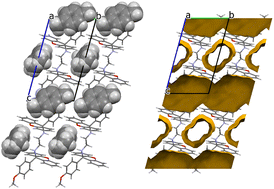
The crystallization of N,N′-bis(9-(4-methoxyphenyl)-9H-xanthen-9-yl)ethane-1,2-diamine (H) from each of the xylene and ethylbenzene isomers (o-Xy, m-Xy, p-Xy and EB) revealed that only the xylenes formed inclusion compounds with this host species, while EB was not included. The host : guest (H : G) ratios of the successfully formed complexes were 1 : 1, 1 : 1 and 1 : 2 for the o-Xy, m-Xy and p-Xy complexes, respectively. Guest solvents were also permitted to compete and crystallizations of H from such solutions revealed an unequivocal host selectivity in the order o-Xy > EB > m-Xy > p-Xy. Further binary guest competition experiments also demonstrated that this host species may serve as a purification tool, through host–guest chemistry protocols, of EB and m-Xy solvents that are tainted with small quantities of o-Xy and EB, correspondingly. Single crystal X-ray diffraction (SCXRD) analyses of the three single solvent complexes were employed in order to understand the host selectivity behaviour. The guest molecules in H·o-Xy and H·m-Xy (with guest solvents more preferred by H in the guest competition experiments) were accommodated in endless and unidirectional channels, and all of these guest species experienced (guest)C–H⋯π(host) stabilizing interactions with H. This was not the case for the guest species in H·2(p-Xy) (with the least favoured guest solvent). Here, two distinct types of guest molecules were observed, one being ordered and the other displaying positional disorder over two positions. Both of the latter disorder guest components were involved in this kind of interaction ((guest)C–H⋯π(host)) with H, while the ordered guest species appeared to be held in the complex through, predominantly, steric effects alone, and no (guest)C–H⋯π(host) or other close contacts were identified in this instance. This observation explained the distinct lack of selectivity of H for p-Xy relative to the remaining isomers in the guest competition experiments. Interestingly, the ordered and disordered guest molecules in this complex also occupied separate channel voids in the inclusion compound which were aligned along different axes in the unit cell. Finally, thermal analyses demonstrated that the three single solvent complexes in this investigation possessed comparable relative thermal stabilities as their guest release onset temperatures spanned a narrow range (Ton 39.2–41.7 °C).
- This article is part of the themed collection: Supramolecular & Polymorphism
 Please wait while we load your content...


