


Supercooling behavior in the melt crystallization process of ammonium dinitramide (ADN) and the corresponding regulation strategy
 a
Yinglei
Wang
*ab
a
Yinglei
Wang
*ab
Abstract
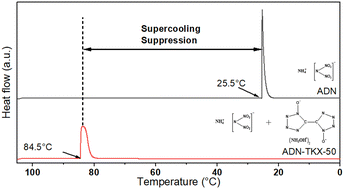
Melt prilling, based on melt crystallization, is a crucial technique for mitigating the hygroscopicity of the green energetic oxidizer ammonium dinitramide (ADN). However, the inherent supercooling properties of ADN result in the formation of supercooling-related defects and rough surfaces during the melt prilling process, ultimately compromising product quality. Consequently, effective regulation of ADN melt crystallization behavior to reduce supercooling is urgently needed. Herein, a novel strategy for reducing ADN supercooling using dihydroxylammonium 5,5′-bistetrazole-1,1′-diolate (TKX-50) as a nucleating agent is reported. TKX-50 modulates the melt crystallization process of ADN by providing heterogeneous nucleation sites, which decrease the supercooling degree from 66.5 °C to 7.5 °C. Meanwhile, the incorporation of TKX-50 significantly enhances the crystallization quality of ADN, improving its anti-hygroscopic performance by 19% and increasing its particle hardness by over 20%. Crystallization kinetics analysis indicates that TKX-50 reduces the nucleation energy barrier, accelerates the ordered arrangement of ADN molecules, and thus effectively suppresses supercooling. This study develops a rational strategy for regulating the supercooling behavior in ADN melt crystallization, addressing the limitations of current melt prilling for ADN.
 Please wait while we load your content...


