


 PLATFORM UPDATE:


Numerical investigation of temperature field and thermal stress of β-Ga2O3 crystal by dual heat source coupled laser floating zone method

Abstract
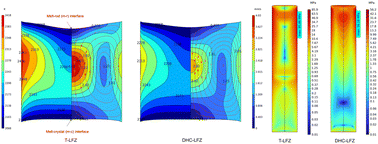
This study introduces a dual-heater-coupled laser floating zone (DHC-LFZ) system to overcome the severe thermal stress and cracking that plague the growth of β-Ga2O3 single crystals via traditional LFZ methods (T-LFZ). The key innovation lies in the integration of auxiliary resistance heaters into the T-LFZ configuration, which allows for active management of the thermal gradient. A multi-physics finite element model, incorporating coupled phenomena of heat flow, melt convection, interface evolution, radiation, and stress, was established. The results demonstrate that with the introduction of the optimized auxiliary heat source, the DHC-LFZ system effectively stabilizes the melt–crystal interface, achieving reductions of 46% and 50.5% in the axial and radial temperature gradients, respectively. Consequently, the maximum axial and radial thermal stresses are curtailed by 49.4% and 58.9%, providing a significantly improved crystallization environment. Our work clarifies the underlying mechanisms linking thermal field control to crystal quality and offers a viable path toward the low-stress growth of large-sized β-Ga2O3 crystals.
 Please wait while we load your content...


