


Effect of N–H–S codoping on high-pressure synthesized diamond along the (100) crystal plane
 *ab
Yong
Li,
c
*ab
Yong
Li,
c
Abstract
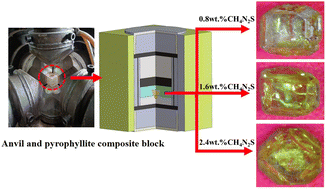
The synthesis of diamonds containing specific target elements is crucial for developing diamond properties. Nitrogen (N), hydrogen (H), and sulfur (S) are key elements that alter the characteristics of diamond. But, further development of diamonds is hindered by the difficulty in synthesizing high-quality diamonds due to the presence of S. In order to diversify the preparation routes for diamonds containing specific target elements and to synthesize high-quality sulfur cooperative multi-element-doped diamonds, this study selected CH4N2S doping within the FeNiCo–C synthesis system to simulate the sulphide multi-element interaction environment present in natural diamond growth and successfully synthesized yellow diamonds exhibiting a hexa-octahedron morphology. Fourier transform infrared (FTIR) analysis indicates a gradual increase in nitrogen content in the synthesized diamonds with increasing CH4N2S doping concentration. The nitrogen existence form transitions from nitrogen C-centers to a coexisting form of nitrogen C-centers and A-aggregated nitrogen. Combined with X-ray photoelectron spectroscopy (XPS) analysis, it was found that the diamond synthesized with 1.6 wt% CH4N2S doping contained the target dopant elements nitrogen (N), hydrogen (H), and sulfur (S). Specifically, H existed in the diamond as –CH2– bonds and –CH3 groups, while S was present as C–S bonds. Raman spectroscopy characterization indicates that all three synthesized diamond samples exhibit a single sp3-hybridized diamond phase with good crystalline quality. This study provides experimental data for synthesizing diamonds containing specific elements. It also offers some reference value for understanding the formation of natural diamonds.
 Please wait while we load your content...


