


 PLATFORM UPDATE:


Multifunctional perovskite materials for energy harvesting and optoelectronic devices
 *ab
*ab
Abstract
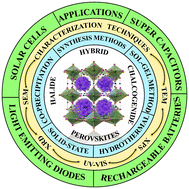
The rapidly growing global energy demand and environmental concerns related to fossil fuel consumption have intensified the search for efficient, sustainable, and multifunctional energy materials. Hybrid organic–inorganic perovskites have appeared as a versatile class of materials owing to their excellent optoelectronic properties, tunable bandgap, low-exciton binding energy, and flexible chemical compositions. In this review article, we present a comprehensive and systematic survey of perovskite materials spanning oxide, halide, hybrid, and double-perovskite systems, with a discussion focused on their structure–property correlations and their significance in next-generation energy conversion and storage technologies. The fundamental aspects, including crystal structure, tolerance factor, bandgap tunability, charge-transport properties and excitonic behavior, are critically examined to establish design principles for specific applications. In addition, this review systematically compares major synthesis routes, solid-state, sol–gel, co-precipitation, and hydrothermal methods, emphasizing their scalability, degree of structural control, and suitability for industrial deployment. Advanced characterization techniques are summarized to correlate the structural, optical, and electrochemical performances. Besides perovskite solar cells, emerging applications in light-emitting diodes, supercapacitors, and rechargeable batteries are reviewed, while key challenges related to stability, lead toxicity, interface engineering, and large-scale manufacturing are critically assessed. Future research directions are proposed to advance lead-free perovskites toward sustainable, high-performance energy technologies. This work aligns with the United Nations Sustainable Development Goal 7 (Affordable and Clean Energy) by promoting efficient and sustainable perovskite-based energy solutions.
- This article is part of the themed collection: 2026 Highlight article collection
 Please wait while we load your content...


