


 PLATFORM UPDATE:


Solvent-controlled stereoselective supramolecular synthesis: a case of diastereomeric dimers of 16-S-dihydrosteviol

Abstract
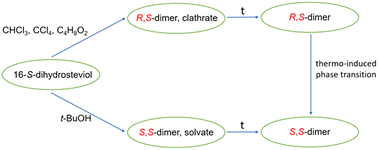
Within the framework of the developing field of supramolecular dynamic stereochemistry, the ability of a steviol derivative to form two stereochemically different types of homochiral dimers in crystals, namely non-symmetrical and pseudo-symmetrical, has been studied. The first type of dimer is formed by molecules of two different supramolecular diastereomers and the second type is formed by two identical ones. The formation of two different supramolecular diastereomeric forms based on the steviol molecule occurs at the stage of formation of hydrogen bonds involving stereochemically identical or different LPs of the hydroxyl oxygen atom. The analysis of the electron density Laplacian function, performed on the optimized geometry of dimers of both types, made it possible to carry out an evidence-based correlation, as well as to visualize the participation of one or another LP in a specific intradimeric hydrogen bond. Controlled conditions for obtaining phases containing dimers of a particular configuration as building blocks and the transition conditions between them were revealed.
- This article is part of the themed collection: Supramolecular & Polymorphism
 Please wait while we load your content...


