


 PLATFORM UPDATE:


Extremely efficient host selectivity behaviour of stable di-(9-(p-chlorophenyl)xanthen-9-yl) peroxide towards ortho-xylene when crystallized from mixtures of the C8H10 aromatic fraction of crude oil
 *a
Eric C.
Hosten
a
*a
Eric C.
Hosten
a
Abstract
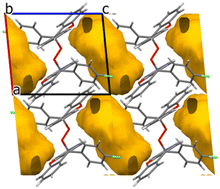
Herein we report on the host ability of di-(9-(p-chlorophenyl)xanthen-9-yl) peroxide (H) for the four isomers of the C8H10 aromatic crude oil fraction, namely o-, m- and p-xylene (o-Xy, m-Xy and p-Xy) and ethylbenzene (EB). Crystallization of H from each of these solvents revealed that both o-Xy and p-Xy formed complexes with this host species, while m-Xy and EB were not enclathrated. 1H-NMR spectroscopic analysis of the resultant solids demonstrated that the host : guest (H : G) ratios for the two complexes were 1 : 1 and 4 : 1, respectively. The host compound was subsequently crystallized from various equimolar and binary non-equimolar mixtures of these isomers, and a remarkable selectivity for o-Xy was observed. In fact, it was demonstrated that H has the ability to separate the 20/80 and 40/60 o-Xy/m-Xy as well as the 40/60, 50/50, 60/40 and 80/20 o-Xy/EB mixtures: extremely high selectivity coefficients (K), in favour of o-Xy, were calculated in each of these instances. This is an extraordinary finding given the difficulty of separating such mixtures by the more conventional fractional distillations owing to the comparable physical properties of these guest solvents. The two complexes as well as guest-free H were subjected to both single crystal X-ray diffraction and thermal analyses. The former technique demonstrated that the preferred guest species, o-Xy, was accommodated in the complex in discrete cavities, while disfavoured p-Xy experienced wide open channel occupation. This observation explains the affinity of H for the ortho isomer relative to p-Xy when guests competed, since enhanced thermal stabilities of complexes are associated with the former type of accommodation (isolated voids). Furthermore, o-Xy experienced nonclassical H-bonding with the host molecule, an interaction type not observed in the case of the para isomer. Additionally, from the thermal experiments, the p-Xy-containing inclusion compound, plausibly as a result of its retention in wide open channels, possessed an extremely low thermal stability at ambient temperature and pressure, while the complex with o-Xy, which occupied discrete cavities, was stable in analogous conditions.
- This article is part of the themed collection: Supramolecular & Polymorphism
 Please wait while we load your content...


