


 PLATFORM UPDATE:


Thermal field simulation and optimization of 12-inch SiC crystals grown in a novel resistance heating furnace
 *a
*a
Abstract
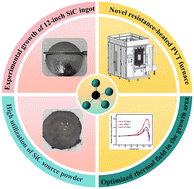
Silicon carbide (SiC) has been widely adopted in power electronics and radio frequency devices owing to its excellent physical properties. However, its high production cost remains a limiting factor for large-scale industrial applications, particularly in emerging fields such as silicon-based device interposers and AR optical glasses. The development of 12-inch SiC crystals therefore plays a critical role in reducing production costs and enabling broader industrial adoption of SiC. In this study, the thermal-field characteristics of 12-inch SiC crystal growth in a novel resistance-heating furnace were systematically investigated through combined numerical simulation and experimental verification. By analyzing the effects of heating power, external insulation, and top insulation on the thermal-field distribution in both the growth area and the raw material area, the optimal conditions were determined to be a heating power of 45 kW with no external insulation and top insulation. This configuration resulted in a low radial temperature gradient of 0.19 °C cm−1 in the growth area. Simultaneously, the high-temperature zone in the raw material area shifted upward, the temperature difference between the upper and lower powder layers was reduced to 3.12 °C, and suitable radial (0.36 °C cm−1) and axial (1.02 °C cm−1) temperature gradients were established. Furthermore, polycrystalline SiC ingots with a diameter of 300 mm and a thickness of approximately 20 mm were successfully grown in the novel resistance-heating furnace, confirming the favorable performance of the optimized thermal field. These results not only validate the simulation model but also provide a practical reference for the growth of thicker, low-defect 12-inch SiC crystals.
- This article is part of the themed collection: Crystal Growth
 Please wait while we load your content...


