


 PLATFORM UPDATE:


Sputtering MoO2 blocking layers for enhancing the efficiency and dynamic response of CZTSSe solar cells
 *a
and
Hailong
Wang
*a
*a
and
Hailong
Wang
*a
Abstract
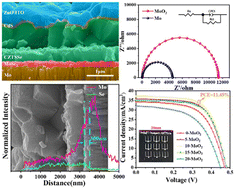
This study investigated the impact of MoOx blocking layers prepared by magnetron sputtering and air-annealing methods on the photoelectric performance of CZTSSe solar cells. The results showed that the MoO2 layer prepared by the sputtering method exhibited more uniform and dense surface morphology, with an optimal thickness of 10 nm for the cell's photoelectric performance. The electrochemical impedance spectroscopy (EIS) analysis revealed that the MoO2 blocking layer effectively suppressed carrier recombination, increasing the recombination resistance (Rct) from 4516 Ω to 11 342 Ω and significantly enhancing the minority carrier lifetime (τ) from 32 μs to 146 μs. Additionally, light response (I–T) testing demonstrated that devices with the MoO2 blocking layer achieved a peak photocurrent (Imax) four times that of the control group under a high duty cycle (PWM = 90%), with an outstanding on/off ratio of 7 × 10⁵ and a shortened pulse rise time (τrising) of 2 μs. These results confirm that the MoO2 blocking layer markedly enhanced carrier mobility and dynamic response by effectively suppressing the formation of MoSe2 and mitigating the decomposition of the CZTSSe absorber layer. Consequently, the device's power conversion efficiency (PCE) was boosted from 8.26% to 11.45%. This work provides valuable insights into interface engineering for developing high-performance CZTSSe photovoltaic devices.
 Please wait while we load your content...


