


 PLATFORM UPDATE:


Study on the influence of the spatial distribution of nitrogen concentration on the uniformity of GaN crystal growth using the Na-flux method

Abstract
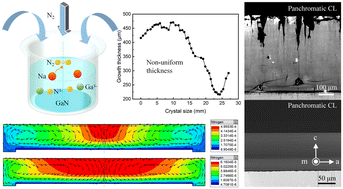
The Na-flux method is one of the key methods for producing high-quality, large-diameter GaN single crystals. However, the non-uniform spatial distribution of nitrogen concentration in the growth system seriously restricts the improvements in crystal homogeneity and device performance. In this study, by combining fluid dynamics numerical simulations with crystal growth experiments, we systematically investigated the melt convection behavior and nitrogen transport under different sodium–gallium composition ratios, revealing that the non-uniform distribution of the nitrogen concentration field in the melt is the direct cause of thickness variation in crystal growth. The results demonstrate that appropriately reducing the sodium content can effectively regulate melt convection patterns, suppress local melt enrichment, and thereby significantly improve the thickness and quality uniformity of the crystal. Experimental verification showed that when the sodium content was reduced to 63%, the thickness peak-to-valley ratio of the crystal decreased from 68.3% to 12.6%, and the thickness non-uniformity was reduced from 25.4% to 4.8%. The FWHM of the (002) and (102) planes improved from approximately 520 arcsec and 265 arcsec to about 105 arcsec and 72 arcsec, respectively. Crystal morphology observations revealed enhanced island coalescence, significantly improved surface flatness, and a more consistent stress distribution across the crystal cross-section, all of which are conducive to the continuous and stable growth of the crystal. This study provides an important theoretical foundation and process reference for the controllable preparation of GaN crystals with high uniformity, large-size, and high-quality.
 Please wait while we load your content...


