


 PLATFORM UPDATE:


Effect of different defect dipoles on the polarization mechanism of Nb-doped SrTiO3 single crystals
Abstract
Although widely recognized for its potential to deliver a colossal permittivity, the origins of this extraordinary property in SrTiO3 are still not fully clarified, necessitating further investigation. In this work, Nb-doped SrTiO3 single crystals were prepared by the Verneuil method, and the influence of different defect dipoles on their dielectric properties was systematically investigated. The study revealed that oxygen-vacancy-associated defect dipoles 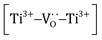 and
and  are effective in localizing free electrons. Under these conditions, electronic polarization mediated by defect dipoles is present in all samples, contributing to a high permittivity while maintaining low loss. The concentration of these defect dipoles, and thus the dielectric performance, can be effectively tuned by varying the doping level and annealing atmosphere. Notably, defect dipoles
  capable of efficiently trapping free electrons lead to superior properties. Ultimately, the SrNb0.5%Ti99.5%O3 crystal annealed in an oxygen atmosphere tends to form more defect dipoles
  , yielding a permittivity of 63 217 and a loss tangent of 0.0208 at 1 kHz. This work provides crucial guidance for designing high-performance SrTiO3-based dielectric materials.

 Please wait while we load your content...


