


Quantitative determination of approximate centrosymmetry in P1 organic crystals
 *a
and
Gil
Alon
*b
*a
and
Gil
Alon
*b
Abstract
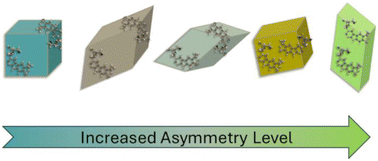
Crystals assigned to the triclinic space group P1(#1) are conventionally regarded as fully asymmetric. However, many of them can be considered as pseudosymmetric, particularly with respect to centrosymmetry. In this work we propose a revised perspective on crystal pseudosymmetry by introducing a quantitative framework based on the Continuous Symmetry Measures methodology. This established method, originally developed to assess approximate point group symmetry in single molecules, is applied here to evaluate the degree of approximate centrosymmetry and inversion mimicry in 2524 P1 organic crystals. A systematic analysis shows that these structures span a continuum of centrosymmetry levels, ranging from nearly centrosymmetric to completely asymmetric unit cells. In addition, our analysis introduces the concept of a kryptoracematism scale, revealing that kryptoracemates occupy different positions along a gradient from approximate racemates to distinctly non-racemic arrangements. By replacing subjective human visualization with a reproducible numerical descriptor, our approach facilitates the analysis of large datasets, uncovers hidden structural insights, and enables the exploration of correlations between approximate centrosymmetry and other chemical or physical properties. This paradigm shift moves crystallography beyond deterministic classification, offering a new way to interpret the subtle structural features of organic crystals.
 Please wait while we load your content...


