


 PLATFORM UPDATE:


Concentration-dependent nucleation of pyrazinamide polymorphs monitored by dynamic light scattering

Abstract
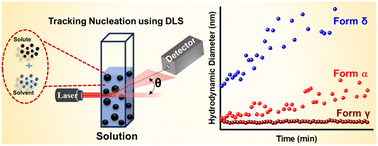
Understanding crystal nucleation in solution remains one of the central challenges in crystallization science, particularly in pharmaceutical systems where polymorphism plays a critical role in determining drug properties. In this study, we present a dynamic light scattering (DLS)-based approach to track nucleation pathways of pyrazinamide (PYZ), a frontline antituberculosis drug known to crystallize in multiple polymorphic forms. Five solvents, ethanol (EtOH), methanol (MeOH), tetrahydrofuran (THF), water (H2O), and acetone, were investigated across three solute concentrations. In contrast to earlier DLS-based studies that primarily emphasize particle size evolution, the present work correlates early-stage DLS signatures with solvent- and concentration-dependent polymorphic outcomes across multiple solvent systems. In EtOH, distinct concentration-dependent nucleation signatures corresponded to the γ-, α-, and δ-forms, whereas MeOH and THF exhibited α- and δ-forms with differing degrees of competition between phases. In contrast, H2O and acetone consistently produced a single stable polymorph (α- and δ-form, respectively), independent of concentration. DLS measurements provided valuable insight into particle size evolution, capturing nucleation events, growth dynamics, and polymorphic selection across solvent systems. Additionally, this work highlights the capability of DLS to differentiate competitive and non-competitive nucleation environments through size distribution behavior, a feature not extensively reported for pharmaceutical systems. Complementary induction time experiments were also conducted to quantitatively assess solvent-dependent nucleation kinetics. The analysis revealed substantial variations in nucleation rates and interfacial energies across the five solvents, providing independent kinetic validation of the trends observed in the DLS measurements. It also represents a significant advancement by enabling both nucleation pathway tracking and induction time analysis within a unified experimental framework by single instrument, providing direct insight into nucleation kinetics. This combined experimental strategy highlights the potential of DLS as a sensitive and non-invasive method to probe nucleation pathways in solution and demonstrates its utility in correlating concentration, solvent environment, and polymorphic outcomes. Beyond advancing the fundamental understanding of nucleation, this approach offers practical promise for monitoring the design of crystallization processes in pharmaceutical and materials science applications.
- This article is part of the themed collection: Supramolecular & Polymorphism
 Please wait while we load your content...


