


 PLATFORM UPDATE:


Effect of ultrasonic field on controlled organic stripping layer formation and its application in electrodeposition of ultra-thin copper foil
 a
Jianyuan
Wang,
b
a
Jianyuan
Wang,
b
Abstract
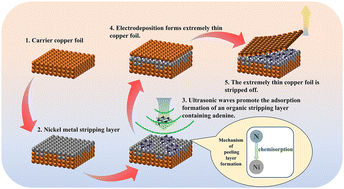
Electroplating is a widely used method for producing metal films, enabling the fabrication of metal foil materials with thicknesses below 20 μm. However, stripping ultra-thin metal films (<5 μm) from the cathode electrode plate remains challenging. Herein, this study reports an efficient electrodeposition process for producing easily peelable ultra-thin copper foil. The method first forms a nickel layer (<1 μm) via electrodeposition on the carrier copper foil. Subsequently, an adenine-based organic stripper is adsorbed onto the nickel layer via “Ni–N” interaction, with ultrasonic introduced during adsorption to enhance bonding effectiveness. DC electroplating of the copper foil on this modified substrate surface enables the production of ultra-thin copper foil as low as 3.5 μm. Research findings indicate that, compared to conventional copper foil preparation methods, this process effectively promotes “Ni–N” formation through ultrasonic treatment. The introduction of ultrasonic assistance during organic stripping layer adsorption results in lower peel strength for the ultra-thin copper foil electroplated on its surface. This facilitates easier, intact stripping of the ultra-thin copper foil while minimizing damage during stripping and storage. Ultra-thin copper foil produced via this method finds primary applications in integrated circuit (IC) packaging, chip packaging substrates, high-density interconnect (HDI) boards, and various high-end electronic products.
- This article is part of the themed collections: Articles behind the 2026 journal covers and Crystal Growth
 Please wait while we load your content...


