


 PLATFORM UPDATE:


Tricolor reversible luminescence switching of a mechano-/vapo-chromic mononuclear Cu(i) complex

Abstract
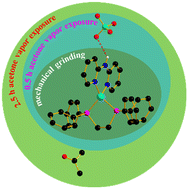
We synthesized two crystalline forms of a novel mononuclear Cu(I) complex (1): an unsolvated form (1-c) and an acetone solvate (1-g). Solvent inclusion dictates the molecular packing mode, leading to the formation of distinct N–H⋯O hydrogen-bonding networks with perchlorate anions. Both forms exhibit reversible tricolor emission switching (green, cyan, and yellow-green) in response to mechanical grinding and time-regulated acetone vapor exposure. This tricolor emission switching is closely correlated with the cleavage, recovery, and modulation of hydrogen bonds (e.g., N–H⋯O interactions), which in turn disrupt, restore, and reorganize the molecular packing pattern. The results demonstrate that solvent inclusion is an effective strategy for fine-tuning luminescence through the precise manipulation of weak intermolecular interactions (e.g., hydrogen bonds), thereby offering a novel design principle for stimuli-responsive luminescent materials.
- This article is part of the themed collection: Crystal Growth
 Please wait while we load your content...


