


 PLATFORM UPDATE:


Directing alendronate structures into 2-D layers with bulky quaternary phosphonium cations

Abstract
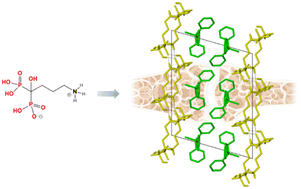
Bisphosphonates are an important class of therapeutic agents for the treatment of bone disorders. Herein, a new class of salts of (4-amino-1-hydroxybutylidine)-1,1-bisphosphonic acid (alendronic acid, LH5) with quaternary phosphonium counter ions [R4P][LH4]·x(H2O) have been synthesised by metathesis reactions of [Ag(LH4)(H2O)]·2H2O with [R4P]Br in water. The crystalline ion pair compounds [Ph4P][LH4]·6H2O (1), [Ph3MeP][LH4] (2), [Ph3EtP][LH4]·4H2O (3), [Ph3PrP][LH4]·H2O (4) and [Ph3BnP][LH4]·H2O·MeCN (5) were obtained in good yield. The tetraalkyl-phosphonium derivative [Bu4P][LH4]·2H2O 6 was similarly prepared, but was only isolated as an amorphous semi-solid which we were unable to crystallise. Compounds 1–6 were highly soluble in water and showed significant solubility in short chain alcohols. A second form of compounds 1 and 3 was obtained by the partial or complete removal of water yielding crystalline [Ph4P][LH4]·0.5H2O (1a), or water free [Ph3EtP][LH4] (3a). Detailed analyses of the crystal structures of the compounds showed discrete [R4P]+ cations arranged into 2-D layers, alternating with 2-D hydrogen bonded sheets of [LH4]− anions and water molecules. The hydrogen bonding within the anion layers was complex but with a consistent head-to-tail pairing of [LH4]− anions, linked by a cyclic R22(16) hydrogen bonded motif. Within the cation layers, there is a strong supramolecular organisation of the phosphonium cations, mediated by edge-to-face (ef) and face-to-face (ff) phenyl–phenyl arrangements. In addition, there are potential weak cation–anion interactions involving non-classical C–H⋯O and C–H⋯π contacts.
- This article is part of the themed collection: Supramolecular & Polymorphism
 Please wait while we load your content...


