


 PLATFORM UPDATE:


Solid-state conformations of pharmaceutical polymorphs in solution: validation and invalidation by NMR.

Abstract
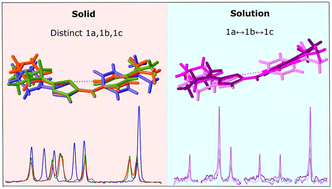
Polymorphism is an important research area in the pharmaceutical industry because it provides understanding of how different crystalline forms of a drug can affect its physical and chemical properties, thereby impacting therapeutic efficacy. While polymorphism is conventionally associated with the solid state, recent studies have suggested that crystalline polymorphs can retain their conformational memory even when they are dissolved in a solvent. Kumar et al. reported that the polymorphic states of the anticancer drug, (Z)-5-(4-(dimethylamino)benzylidene)-2-(piper-idin-1-yl)thiazol-4(5H)-one (1), retained their distinct molecular conformations of the crystal structure even in the solution phase (Crystal Growth and Design, 2023, 23(1), 580–591). The NMR chemical shift perturbations of polymorphs in solution were utilized to establish the presence of distinct conformations by Kumar et al. However, small molecules in the solution state undergo rapid conformational interconversions due to low potential energy barriers, and this makes the characterization of different conformational polymorphs particularly challenging in solvents. Solid-state and solution-state NMR spectroscopies were employed to elucidate the similarities and differences between the spectra of polymorphs of 1 in the solid and solution phases. Our analysis focusses on the spectral patterns and chemical shift differences (Δδ) between signals of different polymorphs, both in solution and the solid phase. Clear structural and chemical shift differences were observed for the crystalline polymorphs by solid-state NMR. In solution, the differences in chemical shifts among the polymorphs are negligible or near the limit of detection, highlighting the importance of caution when interpreting small NMR chemical shift variations as evidence for different polymorphs. The magnitude and origin of the observed 1H chemical shift differences for the polymorphs of 1 are analyzed, and the validated NMR methodology presented herein is expected to be applicable to other conformational polymorphic systems.
- This article is part of the themed collections: Articles behind the 2026 journal covers, Supramolecular & Polymorphism and Celebrating the CrystEngComm Advisory Board and their research!
 Please wait while we load your content...


