


 PLATFORM UPDATE:


Non-precious metal high-entropy NiCoFeMnLa/CNTs@Cr2O3 composite for alkaline seawater electrolysis

Abstract
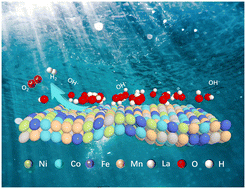
NiCoFe-based multicomponent alloy catalysts have been extensively studied as non-precious metal high-entropy alloy catalysts. They exhibit outstanding electrochemical performance in the electrolytic hydrogen production process. Here, we employ one-dimensional carbon nanotubes as a substrate to prepare a series of carbon-based high-entropy heterostructure catalysts. The NiCoFeMnLa/CNTs@Cr2O3 composite structure is obtained by forming oxides on the surface via vapour deposition, effectively increasing the number of active sites. The carbon-based transition metal nanomaterial catalyst NiCoFeMnLa/CNTs@Cr2O3 exhibited outstanding performance in the alkaline electrolytic catalysis of the oxygen evolution reaction, achieving an overpotential of merely 235 mV at a current density of 10 mA cm−2 in alkaline simulated seawater solution. Notably, the catalyst maintained relatively stable current density during 24 h electrochemical testing, indicating that the NiCoFe multicomponent alloy catalyst combined with Cr2O3 holds promise for enhanced stability during seawater electrolysis. Driven by these findings, this work may offer novel insights into the rational design of highly efficient electrocatalysts for green hydrogen production processes, particularly concerning carbon-based high-entropy alloy nanoparticle catalysts.
- This article is part of the themed collection: Nanomaterials
 Please wait while we load your content...


