


Synthesis, phase evolution pathways, and electrochemistry of phosphate-based cathode materials obtained using hydro/solvothermal treatment from simple oxide precursors
 *a
Oleg A.
Drozhzhin
a
and
*a
Oleg A.
Drozhzhin
a
and
Abstract
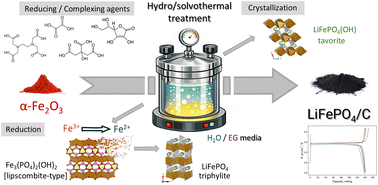
Phosphate-based cathode materials represent a major class of compounds used in the manufacturing of low-cost and safe lithium-ion batteries (LIBs). A significant challenge in this field is developing scalable and cost-effective synthesis routes that yield battery-grade materials meeting industrial standards. This study addresses this challenge by focusing on reagent selection for the hydrothermal synthesis of near-commercial-grade phosphate cathodes. Specifically, we used hematite-type iron oxide (α-Fe2O3) and pyrolusite-type manganese dioxide (β-MnO2) as cost-effective and chemically stable sources of iron and manganese. We investigated phase evolution pathways by adjusting the reducing strength of complexing agents, including citric acid, ascorbic acid, oxalic acid, and ethylenediaminetetraacetic acid, as well as the reaction medium (water or ethylene glycol). This approach allowed us to identify crystallization routes leading to the formation of tavorite (LiFePO4(OH)), triphylite (LiFePO4), and lithiophilite (LiMnPO4). During hydrothermal treatment, the formation of LiFePO4 proceeded through sequential phase transformations from hematite to lipscombite and then triphylite. In addition, we showed that the synthesis conditions and phase transformation pathways were correlated with the resulting electrochemical properties, which explains the origin of the limited electrochemical activity. This study lays the groundwork for future research aimed at optimizing the production of high-performance phosphate-based cathode materials.
 Please wait while we load your content...


