


 PLATFORM UPDATE:


Molecular-level insights into small organic molecule dipyrone crystallization by MD-based strategies
 *ab
Huibo
Meng
*b
*ab
Huibo
Meng
*b
Abstract
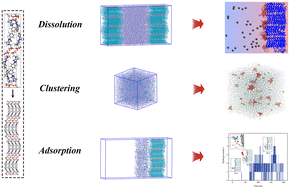
This study employs long-timescale molecular dynamics simulations to investigate the dissolution, prenucleation clustering, and crystal adsorption of dipyrone. Two dedicated visualization scripts were developed to capture dynamic dissolution behavior and prenucleation clustering. In systems with larger molecular weights, excessive dissolution beyond saturation has been observed, likely driven by local solvent concentration gradients resulting from uneven solute distribution. Cluster analysis in four solvents showed that water markedly accelerated kinetics and favored larger aggregates. Acetonitrile induced more clustering than ethanol in pure systems, but the trend reversed in aqueous mixtures, where ethanol–water promoted faster growth and larger clusters. Adsorption on three major crystal planes in ethanol and acetonitrile revealed electrostatic interactions as the dominant driving force, with ethanol producing stronger crystal–solute and crystal–solvent interactions. The (020) plane exhibited the strongest adsorption capacity. However, competition between crystal–solute and crystal–solvent interactions was identified as the key factor governing adsorption strength and probability. These findings provide molecular-level insights into dipyrone crystallization, offer MD-based strategies for studying small organic molecule crystallization, and inform approaches to crystal growth control and solvent selection in pharmaceutical development.
- This article is part of the themed collection: Crystal Growth
 Please wait while we load your content...


