


 PLATFORM UPDATE:


Dimethoxy-substituted triphenylamine-based donor–acceptor fluorophores: tunable solid-state emission and reversible thermofluorochromism
 *f
and
Savarimuthu Philip
Anthony
*a
*f
and
Savarimuthu Philip
Anthony
*a
Abstract
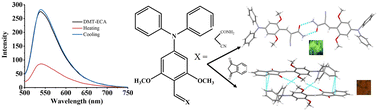
A new series of donor–acceptor fluorescence molecules based on a dimethoxy-substituted triphenylamine donor and different acceptors (malononitrile, ethyl cyanoacetate, cyanoacetic acid, cyanoacetamide, indanedione and dimethyl barbituric acid) was synthesized and investigated for their solid-state structural assembly and tunable and switchable fluorescence. Single-crystal analysis revealed twisted non-planar molecular conformations with acceptor-dependent structural organization and intermolecular interactions. DMT-MN, DMT-ECA and DMT-ID displayed intermolecular interaction-mediated dimer formation with opposite molecular orientations. DMT-CAA and DMT-BA showed network structure, whereas DMT-CA exhibited complementary amide H-bonding in the crystal lattice. Solid-state fluorescence studies showed blue-shifted emission for DMT-CA (λmax = 532 nm), and DMT-ID displayed red-shifted fluorescence at 630 nm. DMT-MN exhibited the highest solid-state fluorescence efficiency of 16.2%. Computational studies supported the fluorescence tuning by showing acceptor group-dependent optical band gaps. It also suggested locally excited (LE) state emission in DMT-CA and charge transfer (CT) state emission in DMT-ID. DMT-ECA exhibited reversible temperature-dependent off–on fluorescence switching. The fluorescence intensity was strongly reduced by heating and reversed to the initial state upon cooling. The reversible thermofluorochromism of DMT-ECA was further supported by a clear phase transition between 100 and 130 °C. PXRD studies confirmed the structural stability of DMT-ECA before and after heating. DMT-MN showed crystallization solvent-dependent tunable fluorescence. The as-synthesized powder and crystals grown from ethyl acetate showed fluorescence at 554 nm, whereas crystals obtained from DCM–EtOH showed fluorescence at 590 nm. However, single-crystal analysis did not show any polymorphism and exhibited only slight variations in molecular conformations. Thus, the current work explored the structure–property relationship of new donor–acceptor molecules and elucidated the impact of molecular structure for achieving thermofluorochromism.
 Please wait while we load your content...


