


 PLATFORM UPDATE:


Controllable construction of base pairing and chirality study in supramolecular assemblies based on guanine nucleotides
 *a
*a
Abstract
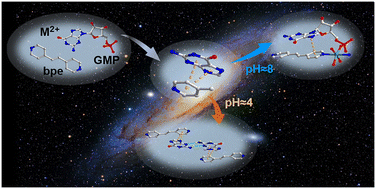
A detailed understanding and investigation of mismatched bases in non-B DNA structures can help reveal the pathogenesis of hereditary genetic diseases and provide a theoretical foundation for the development of gene therapy technologies. Accordingly, this study successfully designed and synthesized three nucleotide-based assemblies using guanosine 5′-monophosphate (GMP) as a building block. The synthesis leveraged a synergistic assembly strategy involving transition metal ions and the auxiliary ligand bpe, controlled by pH modulation. The assemblies are: {[M(GMP)(bpe)(H2O)3]·9H2O}n (M = Mn(II), Ni(II)) (1 and 2) and (HGMP)2(H2bpe)·7H2O (3) (bpe = 1,2-bis(4-pyridyl)ethylene). Comprehensive characterization of 1–3 was conducted through infrared spectroscopy (IR), ultraviolet-visible spectroscopy (UV-vis), X-ray powder diffraction (PXRD) and single-crystal X-ray diffraction. Crystallographic studies revealed that 1 and 2 exist as coordination polymers, while 3 forms an ionic co-crystal. In 3, the bpe ligand serves as a “scaffolding” through multiple π–π stacking interactions, successfully constructing a guanine–guanine base mismatch pattern with high anti–anti glycosidic bond torsion angles. These validate that the strategy exhibits certain general applicability and effectiveness. Furthermore, combining single-crystal structure analysis and solid-state circular dichroism (CD) spectroscopy, the processes of chiral transfer, chiral induction, and chiral amplification in the three assemblies were investigated. It was found that in assembly 3 containing base mismatches, the system energy increases and the chiral signal undergoes a blue shift. This study not only develops a new assembly paradigm for nucleotide-based functional materials, but also provides important chemical model references for deepening the understanding of the molecular mechanism of base mismatches and designing targets in gene therapy.
 Please wait while we load your content...


