


 PLATFORM UPDATE:


Two semiconductive haloargentates with metal-complex cations: crystal structures, band gaps, photocurrent responses and theoretical investigations

Abstract
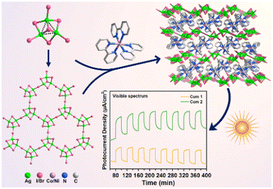
The construction of new haloargentate hybrids with semiconductor nature and photoelectric performances is very fascinating, yet remains challenging. Herein, using in situ-generated [Co(2,2-bipy)3]2+ and [Ni(2,2-bipy)3]2+ metal-complex cations as structure-directing agents, we successfully fabricated two new members of the haloargentate family, namely [NH4][Co(2,2-bipy)3]2Ag6I11 (1) and [NH4][Ni(2,2-bipy)3]2Ag6Br11 (2), respectively. These two compounds are structurally isomorphic and contain two-dimensional [Ag6X11]n5n− (X = I and Br) anionic layers, which are perforated with large hexagonal windows. The characterization of the optical properties of compounds 1 and 2 shows that they exhibit optical band gaps of 1.75 and 2.84 eV, respectively, demonstrating visible light-responsive semiconductor behavior. Under alternating light irradiation, the two as-synthesized materials possess good photoelectric conversion abilities, with their photocurrent densities (0.20 and 0.22 μA cm−2 for 1 and 2, respectively) observed to be comparable with many excellent metal halide competitors. Further, density functional theory calculations disclose that these photosensitive metal complexes play key roles in charge transfer and carrier transport, ultimately resulting in satisfactory photoelectric performances. Additionally, Hirshfeld surface analysis, thermogravimetric studies, and X-ray photoelectron spectroscopy characterization of the title compounds were also conducted in this work.
- This article is part of the themed collection: Crystal Engineering Techniques
 Please wait while we load your content...


