


 PLATFORM UPDATE:


Guest water-induced reversible regulation of proton conduction in a two-dimensional nickel(ii) coordination polymer
 a
and
Dong
Shao
*a
a
and
Dong
Shao
*a
Abstract
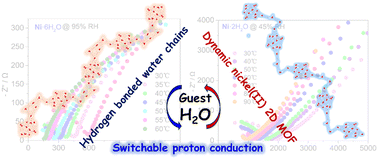
Dynamic molecular crystals with switchable proton conduction are highly attractive for understanding and developing high-performance solid-state proton conductors (SSPCs). Herein, a reversible structural switching was achieved between {[Ni2(btca)(tmdp)2(H2O)6]·6H2O}n (Ni·6H2O; H4btca = 1,2,4,5-benzenetetracarboxylic acid; and tmdp = 4,4′-trimethylenedipyridine) and {[Ni2(btca)(tmdp)2(H2O)6]·2H2O}n (Ni·2H2O) via single-crystal-to-single-crystal (SCSC) transformation during partial dehydration and rehydration processes. AC impedance spectroscopy confirmed that the proton conductivity, which is highly dependent on temperature and humidity, is reversibly modulated by partial dehydration/rehydration cycles, switching the material between a superprotonic state (Ni·6H2O, >50 °C, and 95% RH) and a non-superprotonic state (Ni·2H2O, <10−4 S cm−1, and low RH). The tuning of the 1D hydrogen-bonded water chains is responsible for the reversible electrical switching. This work highlights that the guest species can serve as a switch to regulate proton conduction in coordination polymers and suggests an effective strategy for the construction of dynamic SSPCs via a mixed bipyridyl–tetracarboxylate strategy.
- This article is part of the themed collection: Coordination Networks
 Please wait while we load your content...


