


 PLATFORM UPDATE:


Unraveling potassium segregation in NBT-KBT single crystals and its effect on structural, piezoelectric, dielectric and ferroelectric properties
 *ab
*ab
Abstract
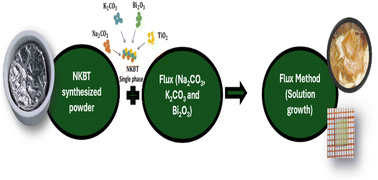
The segregation of potassium ions during the growth of NBT-KBT (Na(1−x)/2 Bi0.5 TiO3-Kx/2 Bi0.5 TiO3) single crystals via the high-temperature solution growth (self-flux) method is challenging. In this context, the present study performs potassium segregation in grown single crystals with varying potassium contents. The incorporation of low potassium content in the grown crystals is confirmed via elemental analysis. Further, a relationship between the initial sodium and potassium concentrations in the solute and their final compositions in the crystal is established. Moreover, the impact of potassium segregation on the structural, piezoelectric, dielectric and ferroelectric properties of the NBT-KBT single crystals is thoroughly investigated. To understand the impact of potassium substitution, structural transformations are analyzed using line profile analysis and Rietveld refinement. Near the morphotropic phase boundary (MPB), the simultaneous presence of rhombohedral and tetragonal phases is observed, leading to a synergistic enhancement of functional properties, such as piezoelectricity, dielectric permittivity, and ferroelectric polarization. Increasing the potassium concentration leads to a rise in the depolarization temperature, implying relatively strong resistance to thermal depolarization. Notably, near the MPB, the piezoelectric and ferroelectric properties reach their maximum, attributed to the structural phase coexistence and optimized domain configurations. Further, the Landau–Devonshire theory describes the temperature-dependent evolution of the ferroelectric behavior, where strong and stable polarization is observed at low temperatures. As temperature increases, domain stability weakens, leading to the emergence of ergodic relaxor characteristics, as reflected by relatively slim P–E loops. These results emphasize the importance of ionic size and domain evolution in enhancing the thermal stability and ferroelectric performance of lead-free NKBT piezoelectrics at the morphotropic phase boundary. These findings provide an effective approach for growing NBT-KBT single crystals with the desired composition and offer insights for optimizing lead-free piezoelectrics for sensor and actuator applications.
 Please wait while we load your content...


